
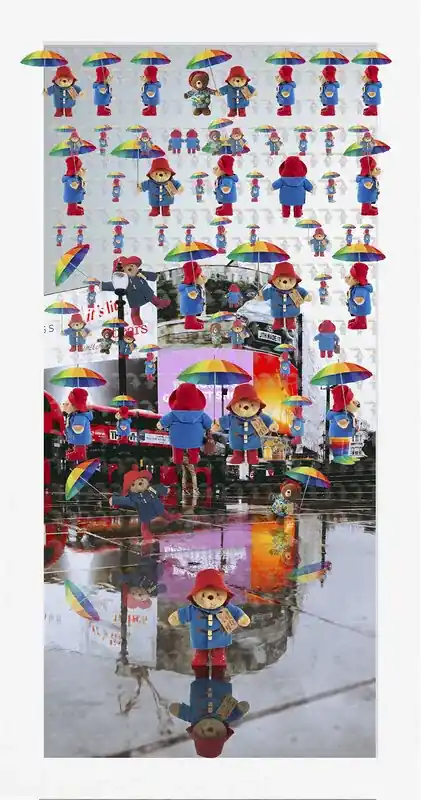
Digital
100 x 210 cm
”It’s raining cats and dogs” is an idiomatic expression used to describe heavy rain. The expression is not literal but carries a more profound meaning beyond heavy rainfall. The origin of this expression is somewhat unclear, and several theories are behind it.
One popular theory is that the expression originated in England in the 1500s, where roof constructions were not always tight enough, allowing rain to come into houses through the roof. When it rained heavily, small animals like cats and dogs could seek shelter on the roofs and then be washed down when the rain became heavy.
Another theory suggests that the expression comes from Norse mythology, where cats were symbols of storms and dogs of rain. When it rained heavily, people believed it was a battle between cats and dogs in the sky, resulting in the heavy rain on earth.
Or that it’s weather so extreme that only dogs and cats are forced to be outside seeking shelter wherever they can, reinforcing the image of extreme and inhospitable weather. In the past, pets were not allowed in the bed, unlike today. It also provides insight into how people’s relationship with pets has changed and how the traditional view of pets as outdoor animals differs from today’s more inclusive attitude towards pets.
Regardless of its origin, the expression has become part of the English language and is used worldwide to describe intense rain. Its poetic and figurative nature adds drama and surprise when used. Despite being an old expression, it is still commonly used and enriches the language with colourful and vivid expressions.
If you don’t want to involve our beloved pets in lousy weather, they are probably safe and sound on the sofa; English has other strong expressions that express disgust for the fury of the elementsdeluge, flooding, monsoon, or more informal pissing down. Swedish ’skitväder’ has its English counterpart – shitty weatherthe same metaphor.
This brings us to a much more pleasant variant, that it’s raining Paddingtons. Then perhaps it’s not about pouring rain but rather a gentle drizzle strong enough to open the umbrella, which the Paddingtons in my picture have also done. Once, when I was in London, and it was drizzling just right from above, I coined the phrase ’Its raining Paddingtons at Piccadilly Circus.’ Look at the picture, and you’ll understand why. The memory of that moment inspired me to compose a picture from London back then. It wasn’t that difficult, even though it took many days to realise the memory images, for Paddington has lived with me for many years. He stands at the foot of my bed, guarding me regardless of the weather.
In the heart of London, in the picturesque neighbourhood of Notting Hill, where the warmth of the people meets the scent of freshly brewed tea, we find a four-legged friend known worldwide – Paddington Bear.
It may seem strange to the uninitiated that a little bear with a blue coat and a red hat can evoke so much joy and appreciation, but that’s precisely what this little bear has done since he first appeared on the pages of a children’s book. Paddington was born from pen and paper by the talented author Michael Bond in 1958, and his popularity has only grown since then, like a smiling bear’s wide-eyed appeal.
Paddington Bear, a fluffy and clumsy figure who loves marmalade sandwiches and is passionate about kindness, has won hearts all over the world. But let’s dig deeper into the story of this delightful bear and his unexpected journey to fame.
It all started in the Peruvian jungle, where Paddington was born and raised among his relatives. He took a detour, but one day, he was discovered by a friendly man named Mr. Brown, who took him under his wing and named him after Paddington Station, where they first met.
But what makes Paddington so unique? Besides his charming naivety and unbreakable optimism, I believe his story captures our hearts. Being born in the jungle in Peru, only later to find himself on a deserted platform in London, is not the journey most of us can relate to. But that’s precisely what makes Paddington’s story so universal. He’s an outsider trying to fit in, a stranger in a strange city, but with an unwavering willingness to embrace life and the people around him.
One of the most iconic parts of Paddington’s look is undoubtedly his luggage tag, the little tag around his neck that states his name and address: ”Please look after this bear. Thank you.” This simple yet powerful tag truly captures the essence of Paddington. He’s a little bear in a big city, a stranger asking for help and kindness, and he’s often embraced and cared for by the people he meets.
But Paddington is not just a symbol of innocence and kindness; he’s also known for his many adventures and funny anecdotes. From rescuing the cat from the neighbour’s roof to trying to fix a mess in Mr Brown’s kitchen, Paddington has had many memorable moments that have captured our hearts and made us laugh out loud.
Paddington’s popularity knows no bounds. From his early adventures in Michael Bond’s books to the beloved children’s film, he has charmed generations of readers and viewers with his innocence and goodwill. His unlikely everyday mishaps and attempts to understand the human world have made him an icon of friendship and tolerance.
One of the most memorable anecdotes about Paddington is his passion for marmalade sandwiches. This bear cannot resist the temptation of a good layer of marmalade between two slices of bread, and his love for this simple pleasure has become part of his personality. In his world, a dropped marmalade sandwich always lands marmalade side up. It couldn’t be otherwise.
But Paddington is more than just a bear with a sweet tooth. He also represents the courage to be different and to embrace the unknown with open arms. Despite coming from another world, he feels at home in London and spreads joy and warmth to everyone he meets.
Paddington’s passion for marmalade sandwiches often leads to problems with handling them smoothly. He gets into sticky situations when making them, like squeezing out too much marmalade or getting it everywhere except on the bread.
Once, Paddington decides to wash his dirty coat, but he has no idea how to use the washing machine, so he puts the entire jacket in there with disastrous results. He frantically presses all the buttons on the machine, and soon, water and foam are spraying all over the laundry room. Poor Paddington looks like a living snowball until the Brown family hears the commotion and rushes to help Paddington. Together, they stop the washing machine and save the coat and Paddington from a wet fate.
Another time, Paddington visits a flea market and gets so excited about all the desirable items that he accidentally messes up the entire place when trying to get a closer look at everything. Paddington manages to mistake an old clock for an alarm clock, which causes chaos when it starts ringing in the middle of the flea market.
Paddington joins an art class and tries to create a masterpiece. But when he accidentally spills paint all over the canvas, he improvises and turns his failed artwork into a colourful abstract painting that unexpectedly succeeds. The Swedish artist Bengt Lindström may have been inspired, or vice versa. Lindström was known for his bright and expressive style, with paintings characterised by bold colours and abstract shapes. Lindström had a significant international career, with exhibitions worldwide, including in Paris, where he also lived and worked for parts of his life. If you can get hold of one of Paddington’s paintings, they will likely be as expensive as Lindström’s.
In conclusion, Paddington is a bear who wears a red hat and a red thread of kindness, humanity, and anti-racism that runs through all his adventures. He reminds us of the importance of being kind to others and always keeping hope alive, even when life throws us into unexpected situations. So the next time you see a little bear with a red hat, remember to smile at him and maybe some marmalade sandwiches – for that’s precisely what he would do for you.
If you pass Paddington Station, look at the little bear with the friendly sign around his neck. He reminds us that the world is full of beautiful surprises and that sometimes it’s worth being open to the unexpected. With his innocent charm and eternal optimism, Paddington Bear symbolises hope and kindness that continues to enchant us all.